
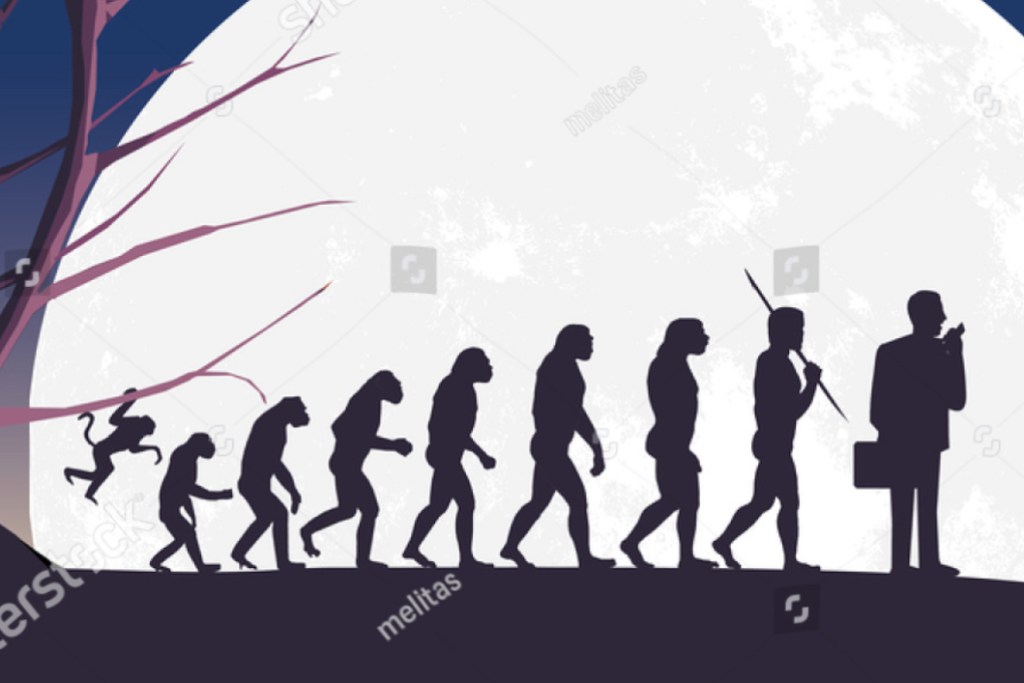
• As many of you know, the “Theory of Evolution” is a topic that is frequently discussed and debated. In this article, we will examine the subject of “Darwin’s Theory of Evolution,” focusing on the most well-known and first-to-come-to-mind figure, the British scientist Charles Darwin.
• His 1859 book “On the Origin of Species by Means of Natural Selection or the Preservation of Favored Races in the Struggle for Life”, commonly known as om “the Origin of Species”, opened the door to many future debates.

What is Evolution?
• In its simplest definition, evolution is the change in populations and species over time. As anyone can observe and study, every living being is born, develops, reproduces, and multiplies. This process of reproduction results in the gradual differentiation of organisms over time, and these differentiations are known as mutations. These mutations accumulate over generations, and the direction of change is influenced by the environment affecting the organism. This process occurs through the system Darwin called “Natural Selection.”

What is Natural Selection?
According to Darwin, “Natural Selection” is a complex process with multiple causes that takes place over a long period of time. Natural selection requires variations or changes within a population, and for this process to function, these variations must be heritable, meaning they can be passed on to the next generation. These variations develop for survival in the struggle for existence and to ensure the continuity of the species. Those individuals that are best adapted to their environment are “selected,” meaning they survive.

Let’s consider a population of insects, as illustrated in the image above. In this population, there are green and brown body colors. A bird species, which is the natural predator of these insects, preys on the green ones, spotting them easily on the trees where they live. As a result, the population of green insects significantly decreases. Based on this outcome, the advantageous trait—brown color—becomes more common in the population. If this process continues, eventually all individuals in the population will be brown.
• If you have diversity, different reproduction methods, and inheritance, you will ultimately have evolution through natural selection. It’s that simple.
• In summary, those that are more resilient to their environment (those that can adapt best to their living conditions) will survive and pass on these traits to the next generation. At the core of this process are the following observations made by Darwin:
• Changes are often passed on to the next generation.
• Resources in the environment are limited, and more offspring are produced than the environment can support.
• Offspring will vary in terms of inherited traits. Offspring in any given generation will be somewhat different from one another in their characteristics (such as color, size, shape, etc.), and most of these traits will be heritable.
Darwin’s Theory of Evolution
• Darwin proposes that species change over time. He suggests that new species arise from already existing ones and that we share a common ancestor. He argues that all discovered and existing species have gradually accumulated unique hereditary (genetic) differences over long periods of time from a common ancestor.

• At the same time, Darwin creates a multi-level “tree” that connects all living organisms, and later scientists add their interpretations to this tree model, creating their own trees.

“Darwin creates a multi-level ‘tree’ that connects all living organisms.”

“The Tree of Life as Seen in Haeckel’s The Evolution of Man (1879)”
• Darwin named the process by which the hereditary characteristics of groups of organisms change over generations “descent with modification.” Today, we refer to this as evolution.
Fundamental Principles of Darwin’s Theory of Evolution
• The scientist Ernst Mayr defined Darwin’s Theory of Evolution in 1982 with the following principles:
1. Evolution, when considered alone, is the change in an organism’s lineage over time.
2. The idea of a common ancestor proposed by Darwin is fundamentally different from the Evolution Theory put forth by Lamarck.
3. Gradual evolution is one of the cornerstones of Darwin’s Theory of Evolution.
4. The change in character distribution within populations forms the foundation of Darwin’s Theory of Evolution.
5. The primary mechanism of evolution is Natural Selection.
SOURCES
- Barros, D. BENJAMİN, 2008, “Natural Selection as a Mechanism”, Philosophy of Science, 75(3): 306–322. doi:10.1086/593075 Erişim tarihi: 09.12.2023
- Ç. M. Bakırcı. Darwin’in Evrim Teorisi Nedir, Neler Söyler?. (29 Ekim 2014). Alındığı Tarih: 9 Aralık 2023. Alındığı Yer: https://evrimagaci.org/s/2917Erişim tarihi: 09.12.2023
- David MASCİ, Darwin and His Theory of Evolution Erişim tarihi: 09.12.2023
- Fatih ÖZGÖKMAN, Yaşamın Kökeni, Evrim ve Tanrı Erişim tarihi: 09.12.2023
İnternet Kaynakları https://evolution.berkeley.edu/evolution-101/mechanisms-the-processes-of-evolution/natural-selection/ Erişim tarihi: 09.12.2023

 VETEXPLAIN