
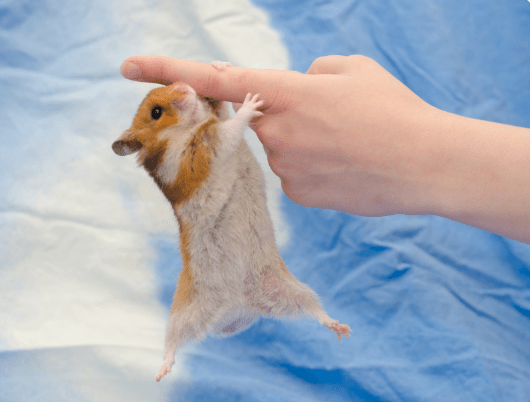
When it comes to pets, cats and dogs are often the first animals that come to mind. However, in recent years, the presence of hamsters with their large, adorable cheeks has become undeniable.
So, what do we know about these little companions we share our lives with?

First, let’s take a look at the general characteristics of hamsters:
Hamsters are omnivores and have 16 teeth. They are rodents with broad heads and short, thick tails. They have cheek pouches that extend to their shoulders and can expand. These pouches are used to store food or carry their young, and they do not have any glands in their pouches. Their skin is not tightly attached to their bodies and is quite flexible. Their gestation period is very short, and as a result, their young are born before their development is fully complete. Over the following days, they continue their development.
There are many adorable species of hamsters, and let’s take a closer look at some of the most popular ones.
SYRIAN HAMSTER

Due to their cute and docile nature, Syrian hamsters are one of the most common pets. These cute, furry babies are also known as golden hamsters or teddy bear hamsters.
They typically have a golden brown color, a slightly round belly, a stubby tail, and small eyes. Their size is around 15-17 cm, and their weight ranges from 100-140 grams. Syrian hamsters have an average lifespan of 2-3 years, and they are considered one of the friendliest hamster species due to their ease of domestication and gentle behavior toward humans. However, they are solitary animals and may harm each other when kept together in the same environment.
ROBOROVSKI HAMSTER

Roborovski hamsters are the smallest hamster species and are known as the fastest among the dwarf breeds. They are also called Robo dwarf hamsters due to their small size.
They have a sandy brown color with a whitish belly and distinctive white markings on their ears and above their eyes. Their size is 5-7 cm, and they weigh between 20-25 grams. Their average lifespan is 3-4 years.
They are social with other hamsters but tend to be possessive of their belongings and are very shy. Therefore, they do not like being touched.
WINTER WHITE HAMSTER
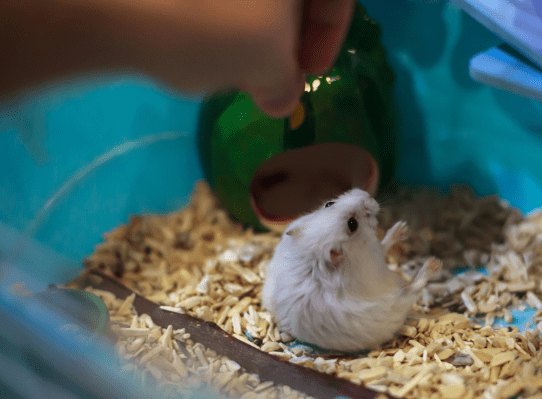
As the name suggests, Winter White dwarf hamsters originate from snowy regions. They are also known as Siberian hamsters or Djungarian hamsters. Interestingly, their fur turns white in winter to help protect them from predators.
Their fur is thick and dense, and they have a black stripe running along their backs. They have round faces, furry feet, and small ears.
Their size is 7-10 cm, and they weigh between 19-45 grams. They are expected to live for about 1.5-2 years.
They are easily domesticated, cute, playful, quite active, and very social with their own species.
CHINESE HAMSTER

Chinese hamsters are small rodents originating from the deserts of China and Mongolia. Due to their sharp sounds and distinctive tails, they are often compared to mice.
Their size is 8-13 cm, and they weigh between 30-45 grams. Their average lifespan is 2.5-3 years.
Chinese hamsters are quite friendly, but they require a lot of attention and time. Without sufficient interaction, they may start gnawing on anything they can get their teeth on, meaning they are prone to behavioral issues when not properly engaged.
CAMPBELL HAMSTER
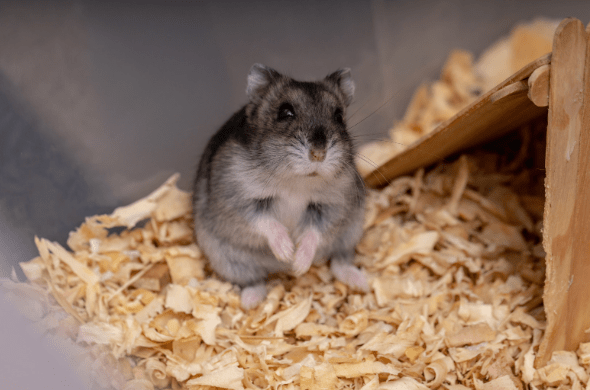
Campbell’s dwarf hamsters have a cute appearance with their round bodies and small size. In pet stores, these hamsters are commonly named based on their fur colors, such as “yellow pudding,” “blue pudding,” or “sapphire” hamsters.
Their size is around 10 cm, and they typically weigh about 27 grams. Their lifespan ranges from 1.5-2 years.
Campbells may bite when startled or irritated. They tend to stay awake and show energetic behaviors when they receive attention. Despite their stubbornness and quick-to-fear nature, they are very affectionate.
This blog post has been verified by Veterinarian Ekin TOPKAYA.
SOURCES
Ankara Üniversitesi Açık Ders Malzemeleri.Moor‐Janowski, J.
“Comfortable Quarters for Laboratory AnimalsRevised edition, Washington, DC: Animal Welfare Institute”. Journal of Medical Primatology. 12 (3): 167-168. doi:10.1111/j.1600-0684.1983.tb00069.x. ISSN 0047-2565.
Fritzsche, Peter (2008). Hamsters : everything about selection, care, nutrition, and behavior. Hauppauge, NY: Barron’s Educational Series. ISBN978-0-7641-3927-7. OCLC174138864.




 VETEXPLAIN