

What is Transitional Cell Carcinoma (TCC)?
Transitional cell carcinoma, commonly abbreviated as TCC, is a type of cancer originating from transitional epithelial cells. These cells line the renal pelvis, ureters, and bladder. This cancer, resulting from the tumorigenic transformation of these epithelia, is one of the most common types of bladder cancer. However, it accounts for only about 2% of all cancer cases. While it is rare in cats, it is more commonly observed in dogs. TCC is more frequently seen in older and female animals. Although the exact cause of the disease remains unknown, several risk factors have been identified.
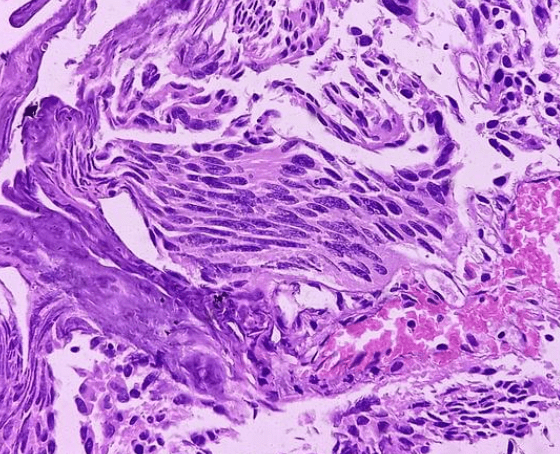
How is it Diagnosed?
TCC is often confused with other urinary tract disorders, which makes diagnosis challenging. The most common clinical sign of highly invasive TCC is urinary tract obstruction. Other possible symptoms include hematuria (blood in the urine) and changes in urination habits, which can provide valuable information to veterinarians. However, these signs can also be caused by other urinary tract infections and are not sufficient for a definitive diagnosis.
In rare cases, the tumor mass may be palpable, particularly in advanced metastatic stages. Routine blood tests generally do not show significant tumor-related abnormalities. Urinalysis typically reveals substantial hematuria, but again, this may not offer definitive clues pointing to cancer. Imaging techniques can be highly beneficial for diagnosis. Ultrasound is commonly used, and in cases where ultrasound is insufficient, CT scans and cystoscopy become crucial diagnostic tools. A definitive diagnosis is made through biopsy, which can be obtained via cystoscopy or surgical procedures. Staging the tumor is vital, and close communication with pathologists is essential during this phase.
Which Breeds Are Predisposed?
Scottish Terriers have been shown to be 18–20 times more likely to develop TCC. Shetland Sheepdogs, Beagles, West Highland White Terriers and Wire Fox Terriers are also 3–5 times more predisposed. Other breeds are under investigation for potential predisposition.

What Are the Risk Factors?
Risk factors are elements that increase the likelihood of developing cancer. For TCC, identified risk factors include insecticides and lawn pesticides. These risk factors were studied particularly in Scottish Terriers, and statistically significant findings were reported.
What Are the Treatment Options?
Treatment options for TCC include surgical intervention, radiotherapy, and chemotherapy.
•Surgical Intervention: Surgery is only feasible if there is no metastasis and the tumor is located away from the bladder neck and urethra. During tumor removal, a margin of healthy tissue surrounding the tumor is also excised, due to the potential for microscopic tumor cells to exist within seemingly healthy tissue. Most patients present with advanced-stage tumors, making surgery rarely a viable option.
•Radiotherapy: The main challenge of radiotherapy is the bladder’s mobility within the abdominal cavity and its shape changes depending on fullness. Complications such as bladder shrinkage, damage to surrounding tissues, and scarring may occur.
•Chemotherapy: Approximately 10–12 effective chemotherapy drugs have been identified and studied for TCC treatment. These can be administered individually or as part of a multi-drug regimen.
•Metronomic Chemotherapy: This method aims not to shrink the tumor, but to stop or slow its progression. It involves the frequent, low-dose oral administration of chemotherapeutic agents, offering time advantages for both the veterinarian and the patient.
•Intravesical Therapy: This involves placing a catheter and directly administering medication into the bladder. It is not commonly used in dogs, and more studies are needed to evaluate its efficacy.
How Should Follow-Up Be Managed During and After Treatment?
After treatment begins, the tumor size should be monitored weekly via ultrasound. If the expected response is not observed, the chemotherapy protocol should be adjusted. Clinical signs during treatment may not always align with disease progression, since the symptoms of TCC often resemble those of urinary tract infections. For example, while chemotherapeutic drugs may be effective, a concurrent infection might alter the frequency and habits of urination undesirably. Such variables must be taken into account when making treatment decisions.
What Happens if TCC is Not Treated?
Due to limited studies on untreated TCC cases, the exact life expectancy of animals with untreated TCC remains unknown.
This blog post has been verified by Assoc. Prof. Lora KOENHEMSİ
Sources
•Fulkerson, C. M., & Knapp, D. W. (2015). Management of transitional cell carcinoma of the urinary bladder in dogs: a review. Veterinary journal (London, England : 1997), 205(2), 217–225. https://doi.org/10.1016/j.tvjl.2015.01.017
•Glickman, L. T., Raghavan, M., Knapp, D. W., Bonney, P. L., & Dawson, M. H. (2004). Herbicide exposure and the risk of transitional cell carcinoma of the urinary bladder in Scottish Terriers. Journal of the American Veterinary Medical Association, 224(8), 1290–1297. https://doi.org/10.2460/javma.2004.224.1290
•Higuchi, T., Burcham, G. N., Childress, M. O., Rohleder, J. J., Bonney, P. L., Ramos-Vara, J. A., & Knapp, D. W. (2013). Characterization and treatment of transitional cell carcinoma of the abdominal wall in dogs: 24 cases (1985-2010). Journal of the American Veterinary Medical Association, 242(4), 499–506. https://doi.org/10.2460/javma.242.4.499
•Knapp, D. W., Dhawan, D., Ruple, A., Cooper, B. R., Zhang, M., Liu, D., Ramos-Vara, J. A., Bonney, P. L., Fourez, L. M., Enstrom, A. W., Lahrman, S. A., & Tullius, J. A. (2024). Association between cigarette smoke exposure and urinary bladder cancer in Scottish terriers in a cohort study. Veterinary journal (London, England : 1997), 303, 106044. https://doi.org/10.1016/j.tvjl.2023.106044
•Knapp, D. W., Richardson, R. C., Chan, T. C., Bottoms, G. D., Widmer, W. R., DeNicola, D. B., Teclaw, R., Bonney, P. L., & Kuczek, T. (1994). Piroxicam therapy in 34 dogs with transitional cell carcinoma of the urinary bladder. Journal of veterinary internal medicine, 8(4), 273–278. https://doi.org/10.1111/j.1939-1676.1994.tb03232.x
•Naughton, J. F., Widmer, W. R., Constable, P. D., & Knapp, D. W. (2012). Accuracy of three-dimensional and two-dimensional ultrasonography for measurement of tumor volume in dogs with transitional cell carcinoma of the urinary bladder. American journal of veterinary research, 73(12), 1919–1924. https://doi.org/10.2460/ajvr.73.12.1919
•Raghavan, M., Knapp, D. W., Bonney, P. L., Dawson, M. H., & Glickman, L. T. (2005). Evaluation of the effect of dietary vegetable consumption on reducing risk of transitional cell carcinoma of the urinary bladder in Scottish Terriers. Journal of the American Veterinary Medical Association, 227(1), 94–100. https://doi.org/10.2460/javma.2005.227.94
•Raghavan, M., Knapp, D. W., Dawson, M. H., Bonney, P. L., & Glickman, L. T. (2004). Topical flea and tick pesticides and the risk of transitional cell carcinoma of the urinary bladder in Scottish Terriers. Journal of the American Veterinary Medical Association, 225(3), 389–394. https://doi.org/10.2460/javma.2004.225.389




 VETEXPLAIN