

Feline Arterial Thromboembolism is the most common complication associated with heart disease in cats. Since this term will be frequently mentioned throughout the text, we will use the abbreviation ATE. To begin, we can briefly explain this term as the formation of a blood clot in the arteries. The disease that most commonly leads to this complication is Hypertrophic Cardiomyopathy. It refers to a pathological increase in the volume of heart muscle cells, due to a cause that is not yet fully understood.
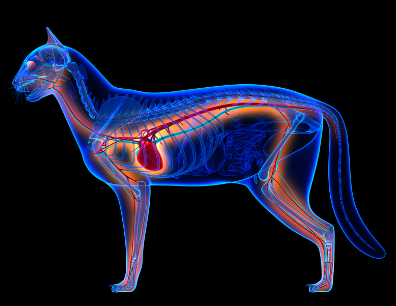
Hypertrophic Cardiomyopathy is a primary myocardial disease that occurs more frequently in cats than in dogs. It is often accompanied by narrowing in the left ventricular outflow tract. Cats typically do not show symptoms, and the disease progresses insidiously. They may become calmer and less active than usual, tire more easily, and appear depressed. Open-mouth breathing and lethargy are among the signs that can be noticed but are often overlooked. During a clinical examination, symptoms such as pale mucous membranes, weak pulse in the hind limbs, dyspnea, and pulmonary edema may be observed. In some cats, ATE may be the first visible sign of the disease.
ATE is the most critical and poor-prognosis complication associated with this condition, occurring in up to 90% of affected cats. The poor prognosis is primarily due to the frequent development of congestive heart failure, which is characterized by fluid accumulation and edema in the body. Congestive heart failure develops in approximately 40–60% of cats with ATE, although it may not be present at the moment the clot forms. In the literature, ATE is referred to as a “silent killer”, as even routine procedures like neutering can trigger embolism formation in an otherwise clinically stable cat.
Left atrial enlargement and decreased function of the left atrium and ventricle are underlying hidden risk factors. Although Hypertrophic Cardiomyopathy is the most commonly associated condition, ATE can also occur with other forms of cardiomyopathy. Additional but rarer risk factors include hyperthyroidism, pulmonary neoplasia (tumors in the lungs that may cause embolism due to uncontrolled growth), and valvular disorders. While clinical symptoms are the starting point, echocardiography is essential to confirm the presence of cardiomyopathy and establish a definitive diagnosis.
Since Hypertrophic Cardiomyopathy is more commonly seen in male cats, ATE is also more frequently encountered in this group. While the average age of onset is 8, it can affect cats of any age. It has also been observed that Abyssinian breed cats may be predisposed to ATE regardless of any underlying heart condition.
The symptoms can be listed as follows:
•Pain (neuromuscular ischemia caused by vascular blockage; restricted blood flow causes tissue damage)
•Paralysis or limping (dragging one or both legs)
•Absence of femoral pulse in the affected limbs
•Coldness in the affected limbs
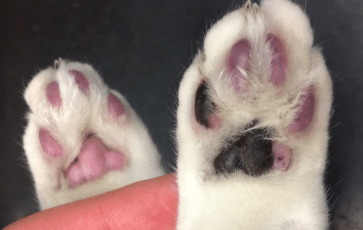
•Pale or cyanotic (bluish-purple) appearance of paw pads
•Loss of reflexes in the tail and perineal area
If your cat seems restless, cries out, or appears distressed, it may be a sign of pain. The intensity of the pain varies depending on the severity of tissue damage in the legs.
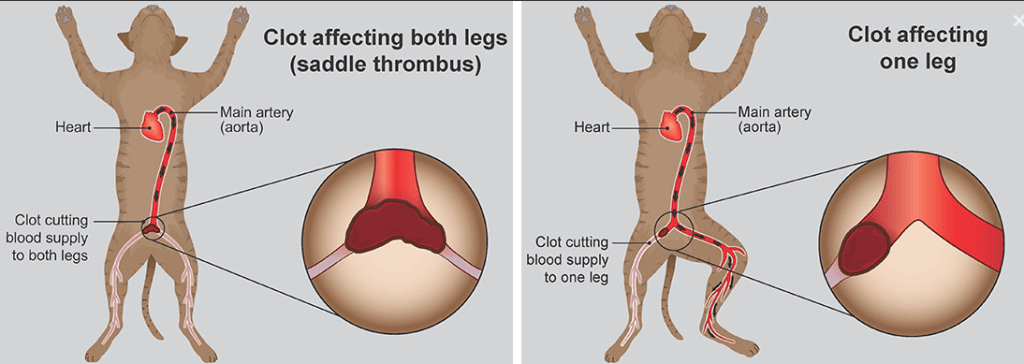
The patient attempts to drag the affected leg or legs; in the vast majority of cases, both hind limbs are affected. This is due to the slowed and thickened blood flow in the left ventricle and atrium caused by cardiomyopathy, which increases platelets—clotting factors in the blood—leading to thrombosis. The disruption in the balance of clotting factors results in hypercoagulation. The formed thrombus exits the heart chambers, travels through the aorta, and lodges in the branching network of vessels leading to the hind limbs, blocking blood flow. If this blockage occurs at the bifurcation point, it is called Aortic Thromboembolism, affecting both legs. The thrombus may also settle in one of the iliac arteries branching from this point, affecting only one limb.
In addition to the coldness of the affected leg or legs, the animal also experiences hypothermia. Symptoms such as arrhythmia, heart murmur, and reduced or absent respiration may also be observed. The first few hours in this condition are critical. If you notice these symptoms, you must visit the nearest veterinary clinic without delay, as the ability to detect such signs already indicates that the disease and its complications have significantly progressed.
This blog post has been verified by Veterinarian Emrullah ÖKSÜZ
Pictures:
Clot busting: Feline aortic thromboembolism
Sources:
Pavelková, E. (2019). Feline arterial thromboembolism. Companion Animal, 24(8), 426–430.




 VETEXPLAIN