
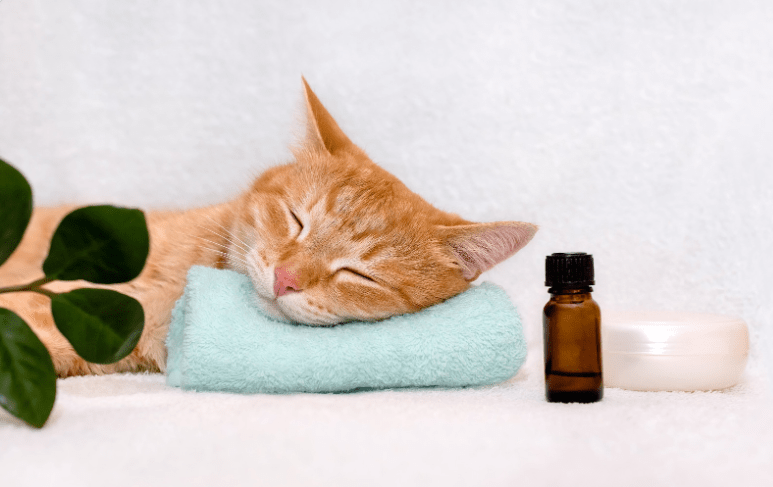
Aromatherapy is a complementary method that involves the use of essential oils to promote mental and physical well-being. Essential oils are highly concentrated plant extracts obtained from the leaves, flowers, roots, or other parts of plants. These oils serve as the plant’s natural defense system and, as supported by current research, possess a wide range of therapeutic properties.
Essential oils have scientifically proven medicinal properties, including anti-inflammatory, antioxidant, analgesic, calming, antibacterial, antiviral, antifungal, antiprotozoal, antimutagenic, anticancer, immunomodulatory, and energizing effects.
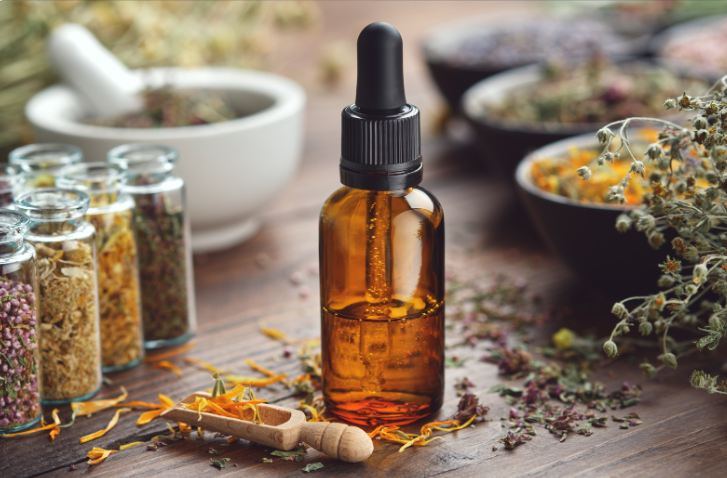
The Use of Essential Oils in Animals and Aromatherapy Applications
The use of essential oils is especially common in traditional Chinese veterinary medicine. For safe use in pets, it is important to pay close attention to species differences, the purity of the product, the method of application, and the concentration of the oil.
Essential oils are produced using one of two extraction techniques:
- Steam distillation, or
- Cold pressing, which is specific to citrus peels or peel oils.
They contain terpenoids and phenylpropanoids as their main components, responsible for the characteristic aroma and biological activities.
Essential oils are lipid-soluble and are rapidly absorbed through the skin. They can penetrate cell membranes that other substances (e.g., antibiotics) cannot, granting them a unique ability to exert intracellular antibacterial and antiviral effects. Findings from studies confirm that most essential oils are quickly absorbed after dermal, oral, or pulmonary application, and are typically metabolized by the kidneys or excreted through the lungs. These oils have been found to be safe at low temperatures.
While research highlights various potential applications of these oils, there is still limited knowledge regarding their use in animals, including dogs and cats. Some essential oils are considered toxic to pets, especially cats. This is likely due to a deficiency in certain liver enzymes involved in metabolic processes (such as UDP-glucuronyl transferase in cats), which can lead to the accumulation of certain active compounds in the body and result in toxicity.
Plants that produce essential oils belong to many genera and are spread across approximately 60 plant families. Notable families known for their medicinal essential oils include:
- Apiaceae (e.g., coriander, cumin, anise, fennel, dill, celery, black cumin): known for their antibacterial, antifungal, anticancer, and antiviral activities.
- Lamiaceae (e.g., thyme, sage, lemon balm, wild mint, peppermint, sweet basil, rosemary, lavender): known for anti-inflammatory, antioxidant, anxiolytic, chemotherapeutic, antiviral, antimicrobial, and antimutagenic properties. Some members of this family are also beneficial for intestinal disorders and bronchitis (e.g., mint, rosemary, basil, sage, thyme, lemon balm, Lavandula species).
- Myrtaceae (e.g., clove, thyme, tea tree, nutmeg, eucalyptus): known for antibacterial, antifungal, antitumor, anticancer, and antiviral properties.
- Poaceae (grasses), including lemongrass oil, also possesses important antimicrobial activities.
Some of the more commonly used anxiolytic essential oils include:
- Lavender (Lavandula angustifolia),
- Rose (Rosa damascena),
- Orange (Citrus sinensis),
- Bergamot (Citrus aurantium),
- Lemon (Citrus limon),
- Sandalwood (Santalum album),
- Clary sage (Salvia sclarea).
Among these, lavender oil (Lavandula angustifolia) is one of the best-researched essential oils, with its anxiolytic effects confirmed in animal models. Numerous studies have shown that it helps reduce hyperactivity and excitability, improves mood, and decreases anxiety and depression. In addition to its relaxing effects, it has also been found to lower plasma cortisol levels and increase coronary blood flow rate.

Mechanism of Action and Use in Animals
In rodent models, studies involving lemon essential oil have shown that its anxiolytic effects likely occur by modulating GABAergic, serotonergic, and dopaminergic systems in the brain.
In terms of free radical scavenging and antioxidant activity, the general ranking of essential oils is as follows:
Lavender > Cinnamon > Nutmeg > Basil > Thyme.
Research has shown that essential oils with anti-tumor properties, such as frankincense and citrus oils (e.g., lemon, lime, grapefruit), contain the compound d-limonene, which is known for its cancer-preventive effects.
Among essential oils, the most active antimicrobial agents include:
Thyme, oregano, tea tree, cinnamon, lemongrass, bay, lemon myrtle, clove, and rosewood oils.
- Eucalyptus and thyme oils have shown inhibitory activity against herpes viruses,
- While tea tree oil has demonstrated significant efficacy in treating recurrent herpes infections.
Applications in Animals
There are three primary methods for applying essential oils to animals:
- Topical application
- Oral ingestion
- Inhalation
Topical application is the most common. This involves rubbing the essential oil into the palms and then gently applying it to areas such as between the toes, paw pads, ear tips, and hairless parts of the skin.
Essential oils can be used alone as treatments, but in veterinary medicine, they are more commonly used as adjunct therapies. They can be applied:
- As part of a preventive health care routine, or
- As supportive treatment for existing conditions such as cancer, drug-resistant infections, or musculoskeletal pain.
In Traditional Chinese Veterinary Medicine (TCVM), essential oils are often used to enhance the effectiveness of acupuncture treatments, aiming to create a calming environment and relax the patient.
Species-Specific Considerations
Certain essential oils have species-specific effects that must be taken into account:
- Cats metabolize medications, scents, and chemicals differently than dogs and humans, and are generally more sensitive to essential oils.
- Due to this sensitivity, topical essential oils must be more highly diluted for use in felines compared to dogs.
- Oils such as tea tree, birch, and wintergreen should be avoided in both cats and dogs due to their potential toxicity.
- Cats should also avoid mint (Mentha spp.) entirely.
Essential oils are also used in other animal species, including birds, exotic animals, and livestock.

When using essential oils, purity is crucial, especially for safe application in veterinary practice. To ensure purity, the term Certified Pure Therapeutic Grade (CPTG) has been established. A CPTG-labeled essential oil means that it has undergone extensive testing by the essential oil company as well as independent third-party laboratories to verify its purity and therapeutic quality.
Examples of Cases Where Aromatherapy Has Been Successfully Used in Treatment:
- A senior dog diagnosed with severe heartworm disease and congestive heart failure,
- A geriatric female Labrador Retriever for musculoskeletal stiffness and pain management,
- In the treatment of anxiety,
- In the treatment of otitis externa in dogs.
This blog post has been verified by Veterinarian Betül Su DOĞAN
Sources:
Shelton M. Animal Desk Reference II: Essential Oils for Animals 2nd Ed. Scot’s Valley, CA: CreateSpace Independent Publishing Platform 2018: 241-244, 256-260, 277-278, 459-461.
Total Wellness Publishing (ed). The Essential Life 5th Ed. Pleasant Grove, UT: LLC Total Wellness Publishing 2018:1-23.
Djilani A, Dicko A. The therapeutic benefits of essential oils. Nutrition, Well-being and Health, Bouayed J (ed). Rijeka, Croatia: InTech Europe 2012: 155-178.
Raut J, Karuppayil S. A status review on the medicinal properties of essential oils. Ind Crops Prod 2014; 62:250-264. doi.org/10.1016/j.indcrop.2014. 05.055
Setzer W. Essential oils and anxiolytic aromatherapy. Natural Products Communications 2009; 4(9): 13051316.
Yip Y, Tse S. The effectiveness of relaxation acupoint stimulation and acupressure with aromatic lavender essential oil for non-specific low back pain in Hong Kong: a randomized controlled trial. Comp Ther Med 2004; 12(1): 28-37.
Judd K (ed). Pursuing Essential Oil Safety with Cats and Dogs. Living Magazine Spring/Summer 2020: 24-26. www.doterra.com/US/en/magazines/doterraliving
Aroma Tools (author). Modern Essentials: The Contemporary Guide to Therapeutic Use of Essential Oils, 5th Ed. Orem, UT 2013: 127.
Kim, Sang-Hun. Kim, Suk. Jun, Hyung-Kyou. Kim, Duck-Hwan, Efficacy of aromatherapy for the treatment of otitis externa in dogs, 2009. https://koreascience.kr/ksci/search/article/articleView.ksci?articleBean.atclMgntNo=TSSOBU_2009_v49n1_85

 VETEXPLAIN