

Plastids are double-membraned organelles found in plants and some algae, the most well-known of which is the chloroplast, responsible for photosynthesis. They are involved in various functions such as food production via photosynthesis, storage of nutrients, and providing color to the cell. Plastids include chloroplasts, chromoplasts, and leucoplasts, and they have the ability to interconvert between one another.
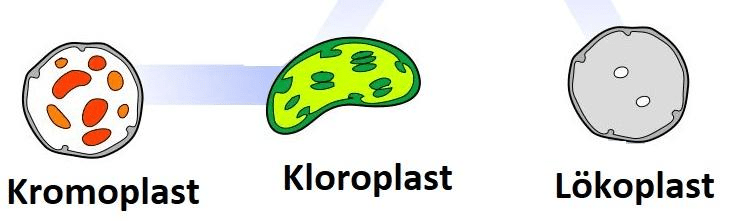
- Chromoplasts give colors other than green to plant cells. They contain xanthophyll for yellow, carotene for orange, and lycopene for red colors.
- Leucoplasts are colorless and serve as storage for starch, oils, and proteins.
Normally, eukaryotic cells that do not have chloroplast organelles cannot produce their own food through photosynthesis. However, there is an exception to this rule called KLEPTOPLASTY.Kleptoplasty is the process by which an organism consumes another organism and retains the plastids from the prey for its own use. This phenomenon usually occurs at the microscopic level but can sometimes be observed macroscopically as well.
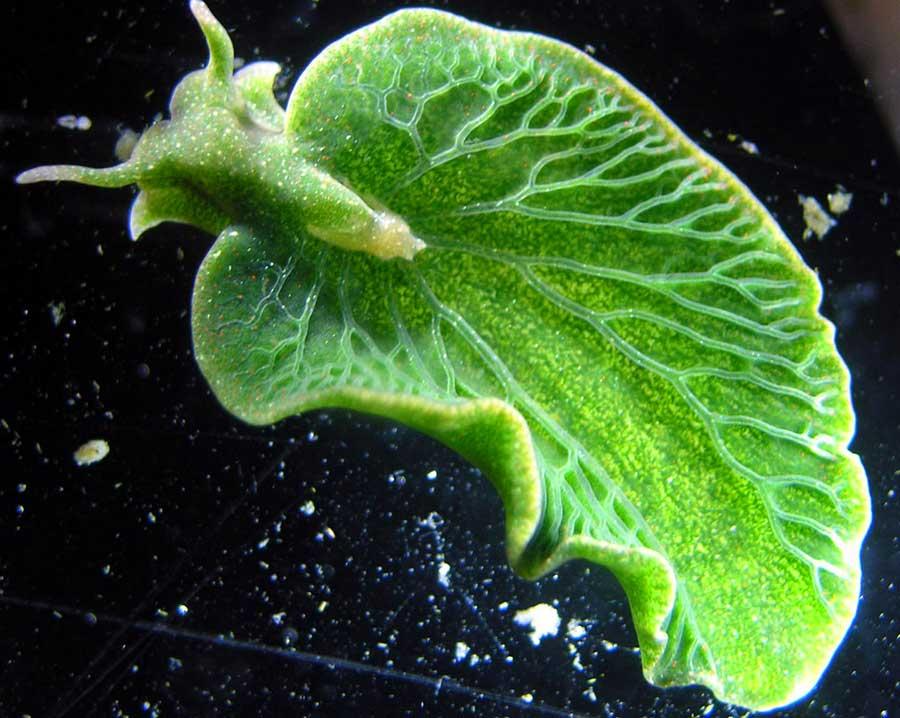

“TÜBİTAK Science Young Magazine Image”
An example of kleptoplasty is the green sea slug Elysia chlorotica, which has a gelatinous, plant-like body. This species is capable of kleptoplasty.
Mary Rumpho from the University of Maine, an expert on E. chlorotica, explains the sea slug’s unique ability as follows:– “Our sea slug performs photosynthesis by ‘stealing’ the photosynthesis genes from the algae it consumes as food.”
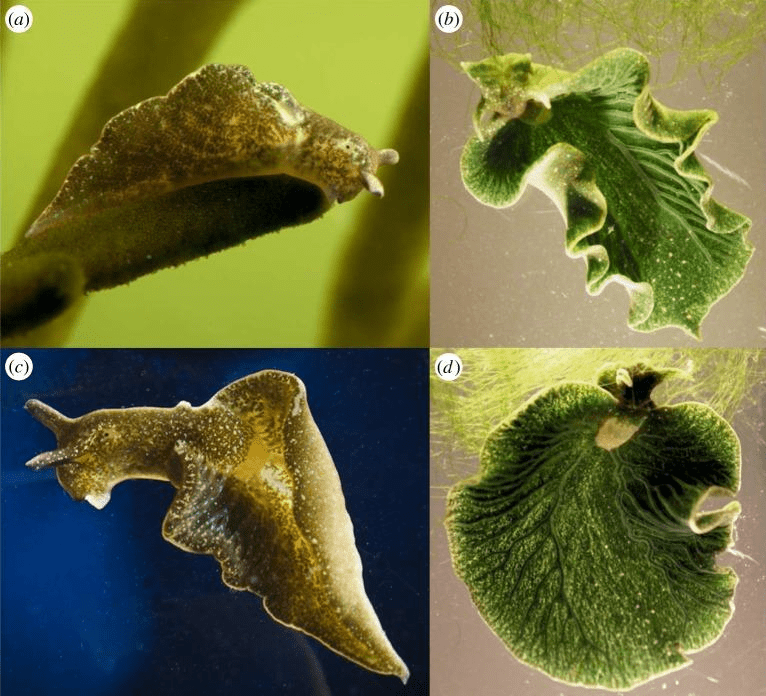
Sacoglossan Sea Slugs Carrying Kleptoplasts. (a) Elysia viridis feeding on Codium tomentosum, and (b) Elysia chlorotica feeding on Vaucheria litorea, with open parapodia visible (c and d, respectively). Images courtesy of C. Brandão (a), A. Kharlamov (c), and M. E. Rumpho & K. N. Pelletreau (b, d).
The key behind E. chlorotica‘s ability to photosynthesize lies in its remarkable process of stealing chloroplasts from the algae it consumes and storing them in its intestinal cells. According to Rumpho’s research, a young E. chlorotica can feed on algae for about two weeks and then survive for up to a year without feeding again, relying solely on photosynthesis.
However, there are still unanswered questions. For instance, chloroplasts only carry DNA that encodes about 10% of the proteins they need to function. The rest of the required genes are located in the nuclear DNA of the algae.
Rumpho explains the mystery as follows:
“So the question was: How can chloroplasts continue to function inside an animal’s body without those essential proteins?”

Genetic Theft
In recent studies, Rumpho and her colleagues fed the sea slug with its favorite food source, the alga Vaucheria litorea, and discovered that the alga’s chloroplasts and genes function in synchrony to enable photosynthesis.
This discovery shows us that a chloroplast alone is not sufficient to carry out photosynthesis.
As a result of this finding, researchers turned their attention to the slug’s own DNA. They eventually identified a key gene in the slug’s DNA that is also found in the alga. Since this gene is an identical version of the algal one, it strengthens the hypothesis that the slug is able to photosynthesize thanks to this gene.
Rumpho commented on the matter:
“We are still unable to fully explain how kleptoplasty works — we are merely making educated guesses.”
- One hypothesis is that both the chloroplast and certain necessary genes are taken from the algae during digestion in the slug’s gut.
- Another, more speculative theory is that a virus present in the slug may act as a vehicle, transferring DNA from algal cells into the slug’s genome.

Can Humans Perform Photosynthesis?
Greg Hurst from the University of Liverpool states that horizontal gene transfer between species is not a new concept, but typically, the DNA transferred does not function within the new organism. Speaking to New Scientist, Hurst explains:
“This is a phenomenon that operates on another level and in a completely different context, which makes it even more fascinating. There was a recent case where an entire bacterial genome was transferred into a species of fruit fly, but whether or not that genome functions is still unknown. What makes this case truly unique is that the transferred gene actually remains functional.”
Mary Rumpho adds her own thoughts on the matter:
“Other animals can also use light energy after consuming plants. But this is only possible because they use whole plant cells—and that’s very different from transforming an animal cell into a solar-powered plant-animal hybrid. As for humans, it’s highly unlikely we could ever become photosynthetic in this way. Our digestive system breaks down all of these materials—both chloroplasts and DNA alike.”
In addition to Elysia chlorotica, other organisms known to perform kleptoplasty include certain marine flatworms, unicellular ciliates, dinoflagellates, and foraminifera.
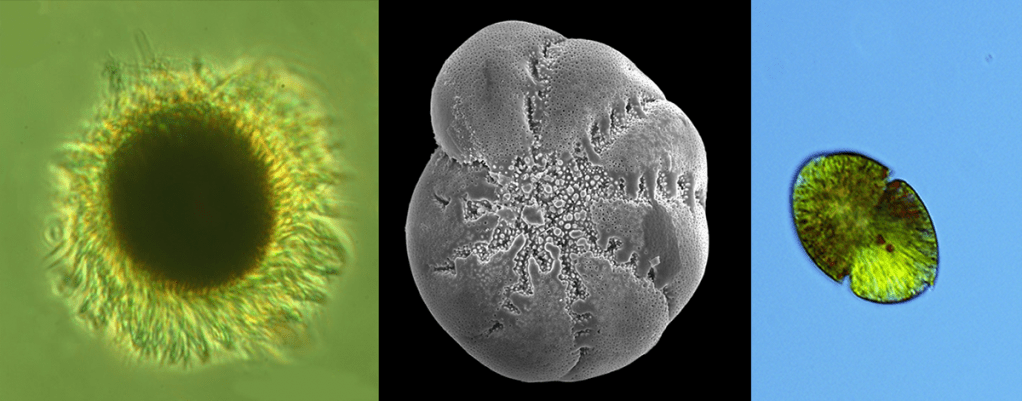
Image from TÜBİTAK Bilim Genç Magazine.
Some species that perform kleptoplasty. From left to right: an example of a unicellular ciliate, a foraminifera, and a dinoflagellate (fire-colored alga).
Sources:
Ayşenur OKATAN, Bilim Genç Tübitak, Hangi Canlılar Kleptoplasti Yapabilir?, Erişim tarihi: 02.04.2024
Catherine BRAHİC, Solar-powered sea slug harnesses stolen plant genes, 24 Kasım 2009, Erişim tarihi: 02.04.2024
Doron Pinko, Sigal Abramovich, Eyal Rahav, Natalia Belkin, Maxim Rubin-Blum, Michal Kucera, Raphaël Morard, Maria Holzmann, Uri Abdu, Shared ancestry of algal symbiosis and chloroplast sequestration in foraminifera, Science Advances, 9, 41, (2023).
/doi/10.1126/sciadv.adi3401 ,Erişim tarihi: 02.04.2024
Web Sources:
https://www.science.org/doi/10.1126/sciadv.aaw4337 , Erişim tarihi: 02.04.2024
https://www.ncbi.nlm.nih.gov/pmc/articles/PMC3949400/ ,Erişim tarihi: 02.04.2024
C. Brahic, et al. Kleptoplazi: Bir Hayvan, Bitki Genlerini Çalıp, Klorofil Üretip, Fotosentez Yaparak Kendi Besinini Üretebiliyor!. (20 Kasım 2011). Alındığı Tarih: 2 Nisan 2024. Alındığı Yer: https://evrimagaci.org/s/514

 VETEXPLAIN