

When we look at nature, we see that some organisms reproduce only once and then die (=semelparity), while others go through multiple reproductive cycles throughout their lifetime before dying (=iteroparity). In this blog, we will explain these two reproductive strategies.
What Is Iteroparity?
Iteroparity is a reproductive strategy in which an organism undergoes multiple reproductive cycles during its lifetime before death. The term comes from Latin: itero meaning “to repeat” and pario meaning “to give birth.” In plants, the term polycarpy is sometimes used instead of iteroparity.
Iteroparous vertebrates include all birds, most reptiles, nearly all mammals, and the majority of fish. Among invertebrates, most mollusks and many insects (such as mosquitoes and cockroaches) are iteroparous. Additionally, most perennial plants are considered iteroparous.
What Is Semelparity?
Semelparity refers to a reproductive strategy where an organism dies after its first reproduction. The term is derived from Latin: semel meaning “once” and pario meaning “to give birth.” Some plant and animal species follow this strategy. For plants, the term monocarpy is sometimes used instead of semelparity. Interestingly, some organisms thought to be semelparous can, under certain conditions, divide their single reproductive period into two or more episodes.
Examples of short-lived semelparous organisms include annual and biennial plants (such as all cereal crops and many herbaceous vegetables), as well as many spider species. Remarkably, there are even semelparous marsupials in Australia. In addition, some long-lived organisms undergo years of growth before reproducing once and then dying—for example, certain species of salmon, as well as bamboo and agave plants.

–Semelparous Wheat

-Spider species

–Salmon
In any iteroparous population, some individuals will die between the first and second reproductive events; however, this cannot be classified as semelparity unless it is part of a programmed post-reproductive death syndrome.
This distinction is also relevant to the difference between annual and perennial plants. Annual plants complete their life cycle within a single season and are typically semelparous, whereas perennial plants live for multiple seasons and are generally (though not always) iteroparous.
The Reproductive Trade-Off
Natural selection favors maximizing lifetime reproductive success. But why would evolution program an organism to die after its first reproduction? In semelparous species, producing a large number of offspring in a single reproductive event provides a clue. By investing nearly all available resources into one large reproductive effort, an organism can reproduce two to five times more than in multiple smaller reproductive events. This raises the question: under what conditions does semelparous reproduction replace repeated, iteroparous reproduction?
Theoretical Approaches
The question, “Under what conditions does semelparity evolve instead of iteroparity?” has been extensively explored in the theoretical literature. These theories generally consider trade-offs between reproduction and survival and can be classified into three categories:
- Demographic Models: When adult survival probability is insufficient, evolution favors semelparity to allocate resources to a single reproductive event, ensuring at least one successful reproductive output.
- Risk-Averse Models: When adult survival is highly variable but there is no risk of losing all reproductive effort, evolution favors iteroparity, spreading reproduction across multiple events.
- Nonlinear Models: These incorporate both the costs and benefits of reproduction. Even when reproductive effort is low, reproduction can occur, and when reproductive effort is high, rapid reproductive output can increase the likelihood of semelparity evolving.
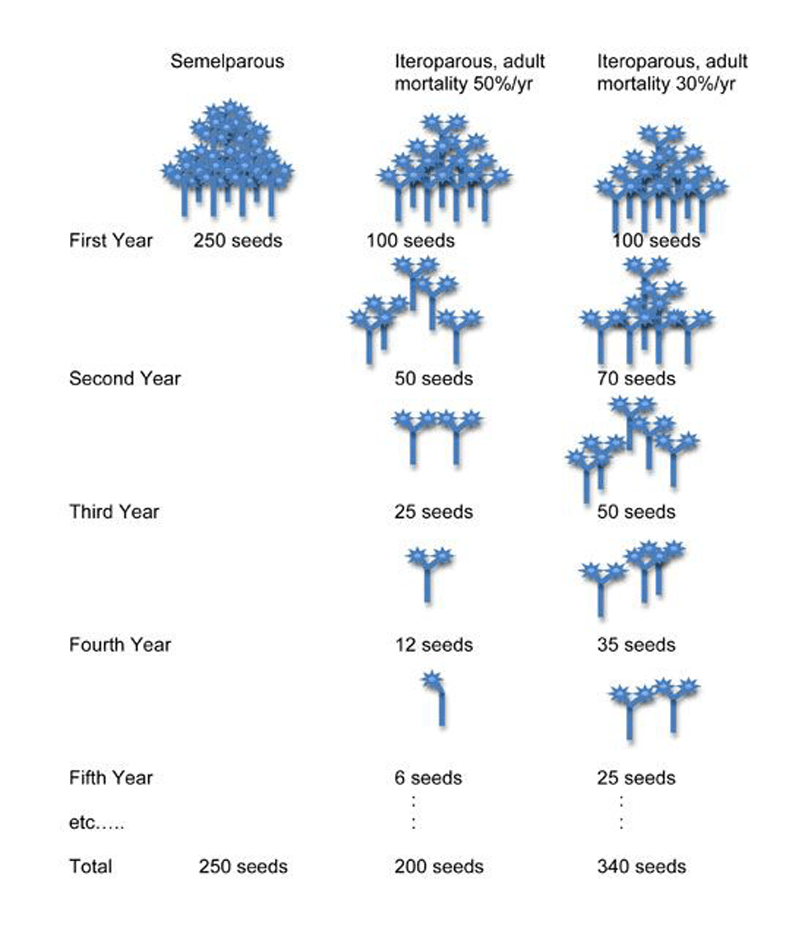
Visual: Demographic Model of Semelparity Evolution
Imagine populations of semelparous and iteroparous species. Semelparous (annual) species produce approximately 2.5 times more seeds than iteroparous species, a reasonable estimate for productivity in natural systems. In the first year, semelparous species reproduce more than iteroparous species; however, iteroparous individuals have the potential to reproduce again in subsequent years.
If 50% of the adult iteroparous population dies each year, an average individual will produce a total of 200 seeds over its lifetime—fewer than the semelparous population. Conversely, if only 30% of the adult iteroparous population dies annually, an average individual can produce 340 seeds over its lifetime, exceeding the semelparous output.
Therefore, in populations with high adult mortality, semelparity is favored over iteroparity. Demographic models of semelparity clearly illustrate this evolutionary trend.
-Evrim Ağacı
Empirical Evidence
Although many theoretical models of semelparity exist, observational tests are limited. Examples include early-flowering desert plants or stunted plants resulting from ecosystem interventions. These situations arise due to large variations in survival rates.
Some tests of demographic models have been conducted with successful results. Even when not all species are semelparous, studies have shown that in species or populations with low adult survival rates, semelparity is more prevalent. These tests have been applied to a variety of organisms, including spiders, fish, a mountain mustard, and a giant rosette plant.
Synchronous Semelparity
In long-lived species, populations of semelparous plants that reproduce in a synchronized manner show an unusual pattern. Some bamboos, certain palm species, tropical canopy trees, and some shrubs exhibit this synchronized reproductive strategy.
Resources
T. P. Young, et al. Doğada Üreme Stratejileri: Semelparite ve İteroparite Nedir?. (14 Ağustos 2017). Date of Usage: 30th May 2024. From: https://evrimagaci.org/s/463
Truman P. Young (Department of Plant Sciences, University of California at Davis), 2010 Nature Education, Date of Usage: 30th May 2024
https://bio.libretexts.org/Workbench/General_Ecology_Ecology/Chapter_8%3A_Life_Histories/4%3A_Semelparity_versus_Iteroparity, Date of Usage: 30th May 2024




 VETEXPLAIN
Yorum bırakın