
General Information
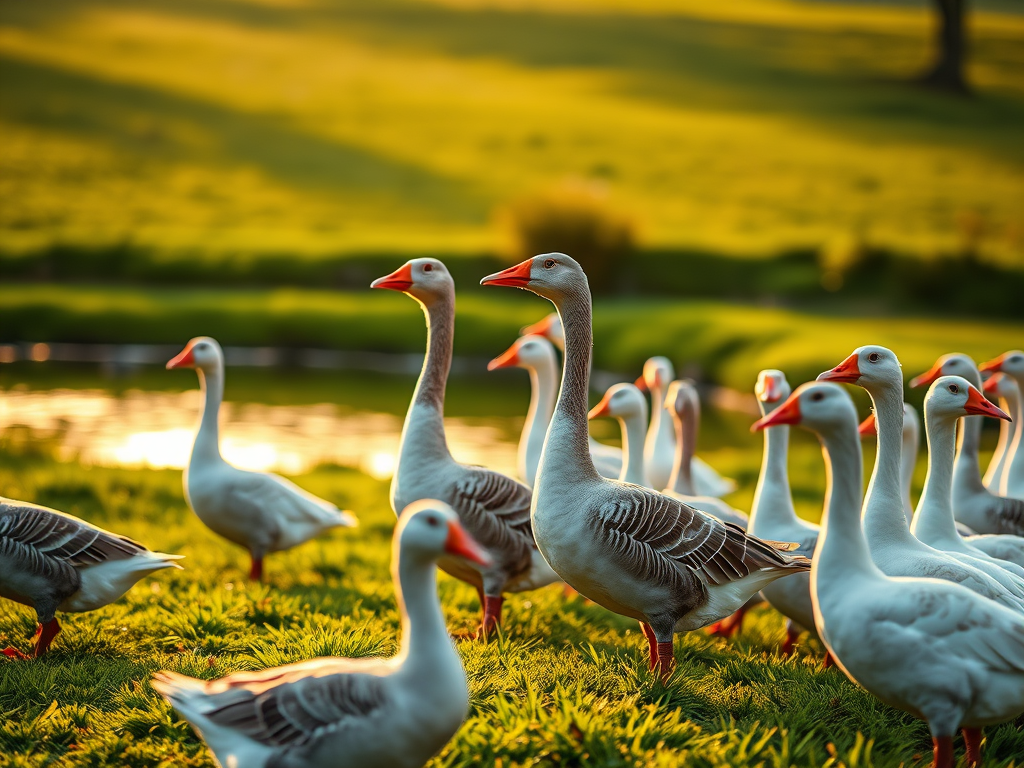
Ducks, geese, and swans belong to the family Anatidae. All of these waterfowl have webbed feet, double-layered feathers, and an extra layer of subcutaneous fat that keeps them warm. These are adaptations to an aquatic lifestyle; however, wild geese are also strong fliers. Most wild geese migrate seasonally in search of safe nesting sites and adequate food sources. Because of their feeding habits, they spend more time on land than ducks, but they still depend heavily on aquatic environments.
Geese are flock birds and typically fly in the characteristic V formation. They also “roost” together on water at night. Flock size provides safety, and strong pair bonds form within the group. When goose goslings are raised, these family bonds remain strong, and the larger the family, the greater their territorial authority.
Geese are almost entirely herbivorous; they consume a wide variety of grasses, reeds, and occasionally insects, including seeds and roots. Their strong, serrated bill is adapted for cutting vegetation, while the gizzard uses grit to break down plant cell walls and extract nutrients.
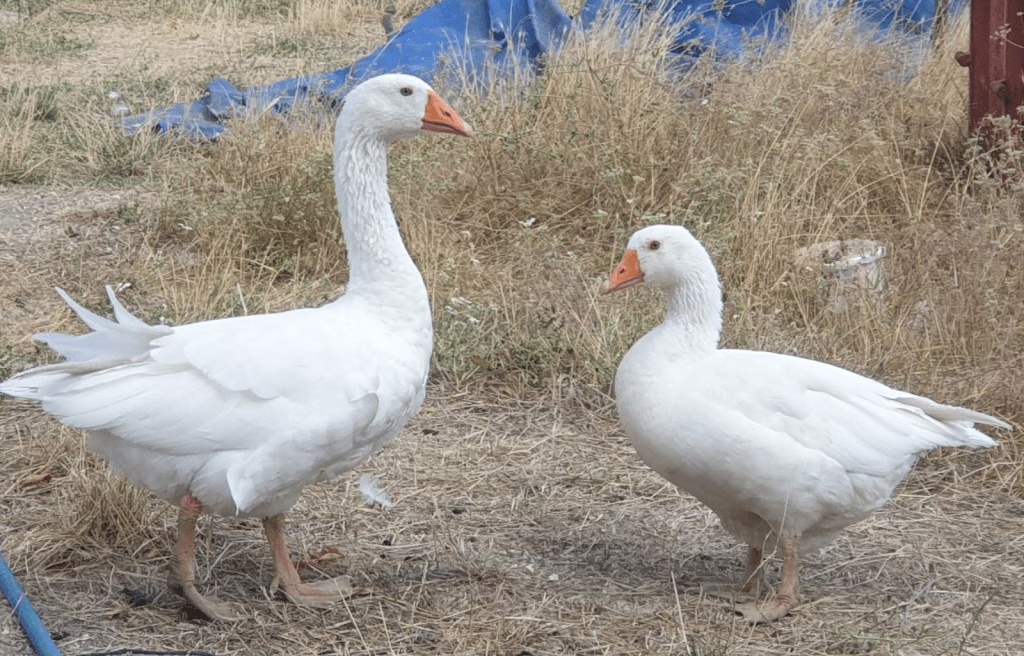
Domestic geese closely resemble their wild relatives. They share the same physiology and nutritional needs, follow similar reproductive and molting schedules, and exhibit similar social behaviors. The primary differences are their larger size, reduced flight ability, and of course, the absence of migration.
History and Temperament of Goose Breeds
Ancient domesticated breeds, such as the Roman goose, are believed to have been selected from the wild Greylag (Anser anser domesticus) and developed through selective breeding. This breed was once widespread across Europe and Asia, wintering in regions such as North Africa, Greece, Turkey, India, and China. Two types of this breed exist with regional differences: the western population has more orange-colored bills, while eastern birds have larger, attractive pink bills and slightly paler plumage. Studies suggest that these color differences stem from natural selection that occurred when the species became divided into two populations by Ice Age glaciation during the Pleistocene. When the ice retreated and populations reunited, the transitional bill and feather colors seen today emerged.
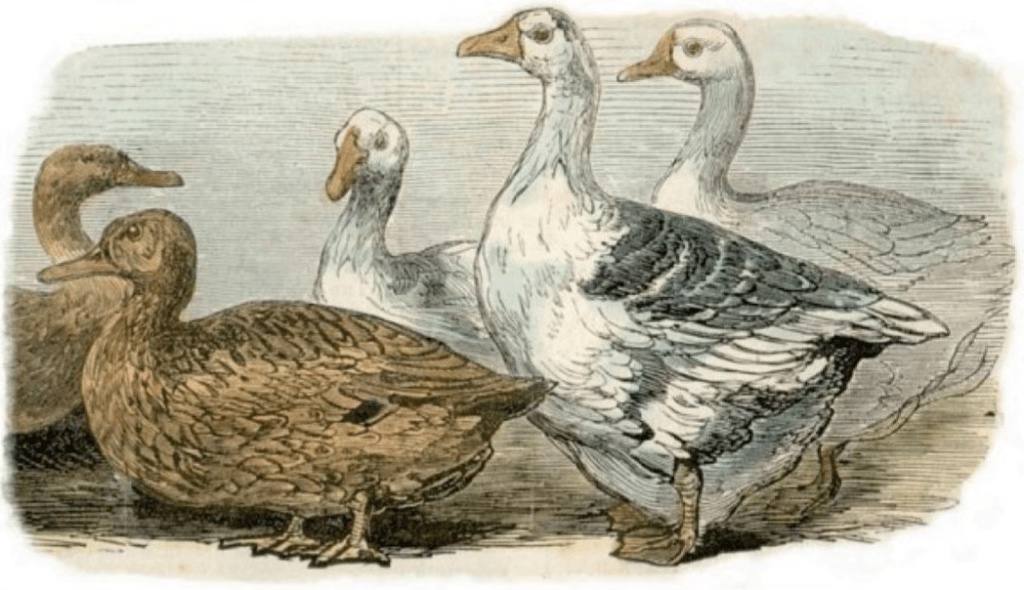
Several factors support the selection of the Greylag for domestication. First, it does not always migrate, and even when it does, it tends to lag behind and cannot keep up with truly migratory species such as pink-footed or white-fronted geese. Second, its wide distribution provided numerous opportunities for domestication. Greylags have a docile temperament and tolerate human disturbance more readily than other species. Among European geese, they are best suited to human-associated habitats and often nest close to human settlements.
Geese have long been valued by humans as farm birds for exhibition, breeding, and food production. Their distinctive qualities set them apart from other poultry: they are easier to handle than more nervous birds, enjoyable to care for because they do not flee easily, and are more intelligent than chickens and ducks. Each goose has its own personality, yet overall, the species displays excellent character. To some degree, temperament varies by breed. African geese are typically the calmest and most docile, with impressive size and voice. Brecon geese are usually gentle as well, though exceptions exist within certain lines. Regardless of breed-based generalities, genetics and upbringing always play a major role.
Goose Ownership
As with all pets and farm animals, welfare comes first. Therefore, if space is limited, if neighbors may complain about noise, or if children are too young to manage them, you should reconsider goose ownership. Geese tie you to the place they live; they cannot simply be left behind when you go on holiday, and someone must care for them in your absence. Predator-proof fencing is essential to keep them safe from threats such as foxes. Before deciding how many birds to keep, consider their needs and start small to observe how well you manage them and how your environment responds.
Geese are often sold in pairs, and unless breeding productivity is desired, it is best to keep them as pairs. A male goose typically bonds with a single female, and if more than one is present, the females may fight. For harmony—especially if the female is receptive to mating—it is easier to maintain a single pair. Geese form lifelong pair bonds in the wild, and domestic geese retain this instinct. Therefore, introducing a new female into an established pair is not recommended, as she will likely be rejected. Never confine incompatible geese together; the dominant bird can seriously injure the other.
Feathers and the Feather Life Cycle
What are feathers made of?
Feathers are composed of a protein-based material called beta-keratin, structurally similar to the scales from which feathers are believed to have evolved. Like hair and nails, keratin is “dead” material. It is strong, lightweight, flexible, warm, and absorbs very little water. Sulfur-containing amino acids are crucial components of feather protein, and geese must obtain them through diet. Therefore, diets rich in sulfur-based amino acids, such as methionine, are essential for healthy feather regrowth. Birds deficient in methionine may chew or eat feathers in an attempt to satisfy this nutritional need—this may explain feather-eating behavior seen in some goslings.
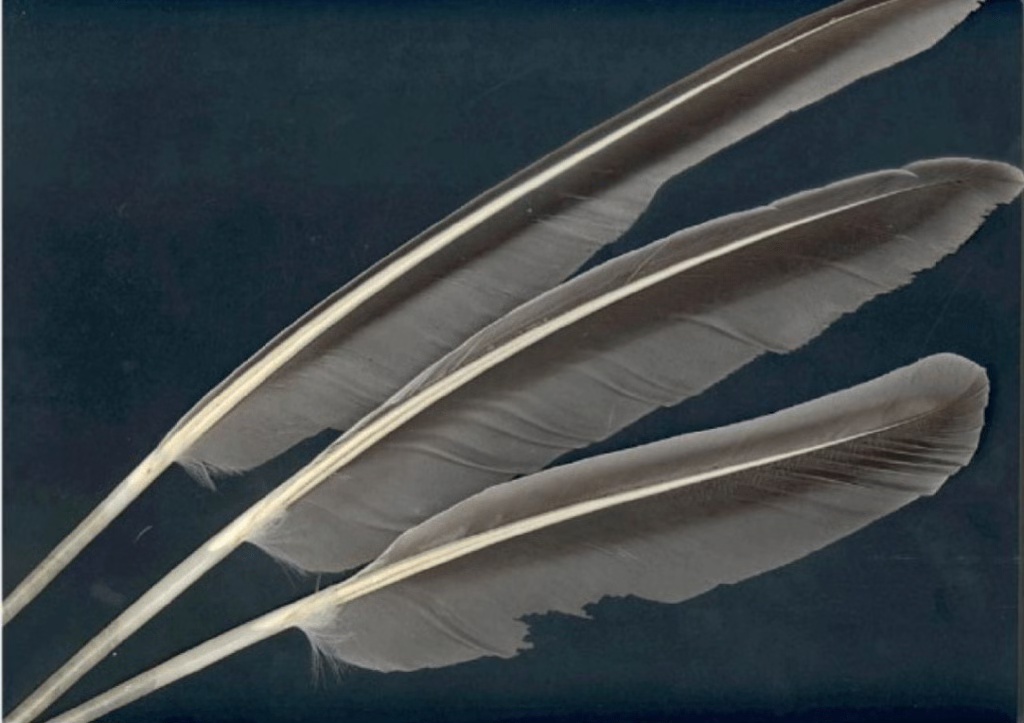
Molting is timed to coincide with migration and breeding. Feather condition and growth stage significantly affect goose behavior. Because feather type and condition influence factors such as warmth, flight, migration, and nesting, they are essential to survival.
Regardless of care, feathers have a limited lifespan. Unlike ducks, which replace their outer feathers twice a year, geese replace their body feathers only once. Because pair bonds are very strong in geese, males do not require bright breeding plumage to attract mates each year, meaning goose plumage is not sexually dimorphic and they do not possess “breeding plumage.” In some species, such as mallards, breeding plumage serves primarily for male display, as males do not participate in raising the offspring.
New feathers form within follicles beneath old ones. Initially, they develop as blood-filled “pin feathers,” but as they mature, blood recedes into the follicle, and the protective sheath splits lengthwise and falls away during preening, revealing the new feather.
Molting is a stressful period, especially for females who have lost much body weight during egg-laying and incubation. Their health and mortality risk during this period are generally worse than in males. In domestic birds, careful management is essential during this sensitive part of the breeding season. Non-breeding geese (older females and unsuccessful pairs) molt earlier than breeding pairs. In wild birds, molting is synchronized, and timing is determined by breeding pairs.
During the vulnerable period when their wing feathers are soft, wild geese move to water with their young for protection. This timing offers an evolutionary advantage by safeguarding the young. As adult geese become more dependent on running rather than flying, their pectoral muscles decrease while leg muscles increase. Goslings also prioritize leg and gizzard development over pectoral muscles. With relatively large feet and strong legs, they soon become capable of running as fast as their parents.
Feeding in Geese
Grass is the primary food source for both wild and domestic geese. Domestic geese often live in confined pastures, so proper grassland management and supplementary feeding—especially in winter when grass quality is low—are essential. Any dietary deficiencies should be corrected with grains and pellets.
Wild geese show great variation in bill size and shape according to their diet. The Swan Goose has a large, long, and heavy bill ideal for pulling up roots and large leaves but poorly adapted for grazing fine grasses. The Greylag, on the other hand, has a “multi-purpose” bill suited for scraping roots, grazing pastures, or stripping seeds from grass.
Geese are inefficient feeders; they are not ruminants and cannot extract cellulose as effectively as cattle and sheep, so they must forage for much of the day. In winter, when daylight hours are short, wild geese must spend seven to eight hours feeding. Their night vision is not well adapted for feeding safely in darkness. This short feeding window around the winter solstice explains why geese accumulate as much fat as possible in autumn to reach their maximum weight by November. These reserves help them survive the harsh winter months until the nutrient-rich spring vegetation appears.
Key Points in Feeding Geese
- Geese fed solely on grass need several hours a day to meet their nutritional needs.
- Autumn and winter diets may include root vegetables such as potatoes, which provide higher energy. Domestic geese also require supplementary feed.
- Herbicides used for weed control must be chosen with great caution.
This blog post has been verified by Vet. Ekin TOPKAYA.
Resources
ASHTON, C. (2012) Keeping Geese: Breeds and Management. The Crowood Press. Date of Access: 02.08.2024



 VETEXPLAIN
Yorum bırakın